FreeClaim: Class Action Money
- 4.7
- Rating
- 10.00K
- Installs
- Free
- Price

 Analysis by App-foxy
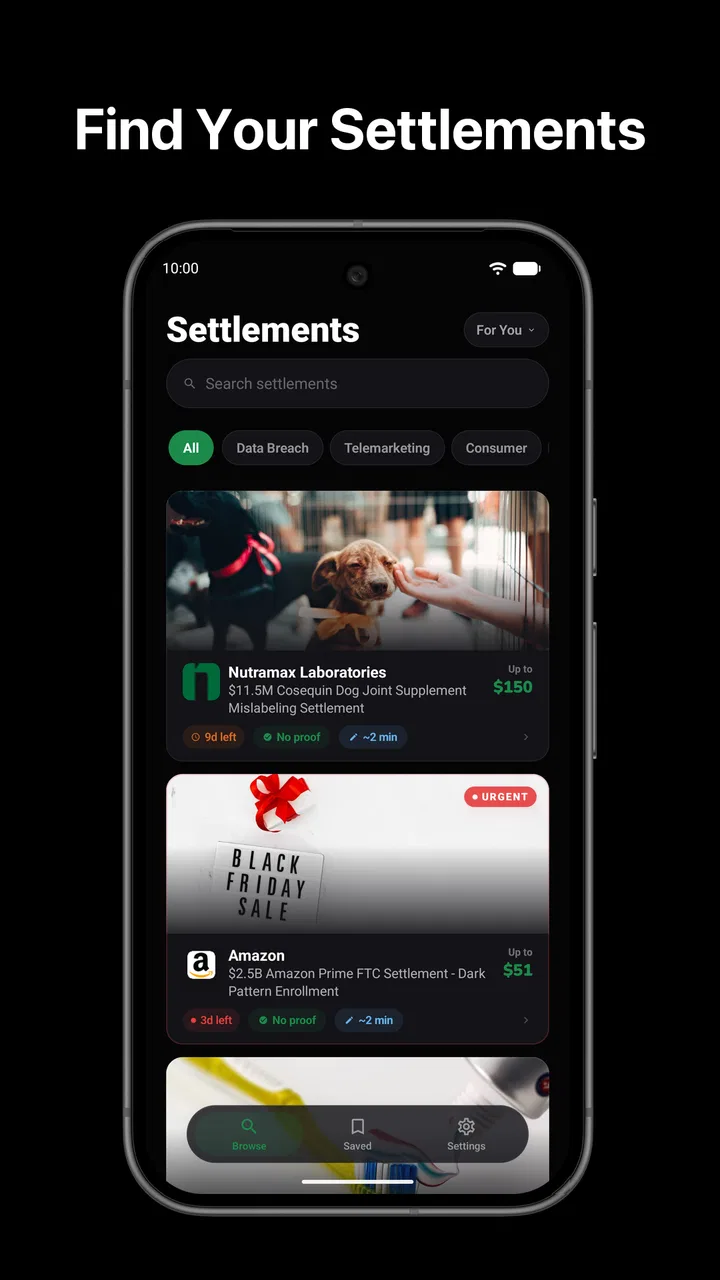
I approached FreeClaim: Class Action Money as a practical finance app rather than something I would open every day for entertainment. Its purpose is straightforward: help people look for class action settlements, rebates, and refunds that may apply to them. That makes it most interesting for anyone who has bought a lot of everyday products or services and does not want to search through settlement notices one by one.
The app comes from Qupid, LLC, and it is free to download. That point matters because the value question is different here from a budgeting app, investment service, or tax tool that asks for a subscription. You can try FreeClaim without paying an entry fee, which makes it easy to decide whether its approach fits the way you handle consumer claims. It is rated for Everyone, runs on Android 7.0 or later, and the current version is 1.4.4.
How FreeClaim fits into real-world claim hunting
Class action settlements are easy to miss because they rarely arrive at the moment when a purchase is fresh in your mind. A notice may use a legal case name instead of the product name you remember, and the deadline can be buried in a long explanation. FreeClaim is aimed at reducing that initial search burden by putting settlement, rebate, and refund opportunities in one finance-focused place.
You May Also Like

 AccuWeather: Weather Radar
AccuWeather Review: A Quick, Clear Forecast for Everyday Decisions
For everyday plans, the best forecast is the one you can understand quickly. AccuWeather makes rain timing, radar, and local conditions easy to act on, with a few trade-offs.

 Hill Climb Racing
Why Hill Climb Racing Still Turns Crashes Into One More Run
A tiny car, a bumpy hill and one more upgrade: Hill Climb Racing keeps resurfacing because its simple chaos makes every near-miss feel personal.

 AliExpress - Shopping App
AliExpress Makes Global Shopping Feel Personal, but Shoppers Bear the Risk
AliExpress turns a global marketplace into a pocket-sized discovery engine. Its reach is useful, its shopping loop compelling, and its trade-offs easy to miss.

 Lords Mobile: Kingdom Wars
Lords Mobile Is a Kingdom-Building Routine, Not a Quick Match
A case-by-case verdict on the building, battles, device demands, and social commitments that make Lords Mobile rewarding for some players and exhausting for others.

 PDF Scanner app - TapScanner
TapScanner Makes Paperwork Easier to Capture, Check, and Share
TapScanner makes scanning with a phone feel less like a rescue operation and more like a dependable step in getting work done. Its capture tools are useful, though not flawless.

 Block Blast!
 Shows How Much a Puzzle Game Can Leave Out
A quiet grid game shows why puzzle players increasingly value instant clarity, repeatable skill and low-pressure play—and where the genre still needs to catch up.
More From Our News Desk
View All News


In my view, the useful idea is not that the app magically creates money. It gives you a starting point for checking whether a claim is relevant. That distinction is important. You still need to read the details, decide whether you qualify, and follow the instructions for submitting a claim. The app is best understood as a discovery and organization aid, not as a guarantee that every listing will apply to you.
A realistic example would be someone cleaning out an email inbox after moving or changing jobs. They may remember buying household goods, signing up for online services, or using a particular brand but have no idea whether any related settlement exists. Instead of searching the web with vague phrases, they can use a dedicated app as a first pass. The potential benefit comes from finding opportunities that would otherwise remain invisible, not from replacing careful checking.
What the free price really means
FreeClaim is available at no cost, so there is no purchase decision before you can explore its basic purpose. That gives it a low-risk role in a personal finance routine: install it, look through the available claims, and keep it only if the results feel relevant. For an app centered on possible refunds, avoiding an upfront charge is especially sensible because a claim may take time to complete and may not lead to a payment.
At the same time, “free” should not be confused with guaranteed financial value. A free app can save you time if it surfaces a useful claim, but it can also produce no direct return if nothing matches your history. I would judge it by the quality of the opportunities I can investigate and by how clearly each one explains the next step, rather than assuming that installation itself has monetary value.
This is also why I would avoid treating the app as a replacement for official settlement instructions. If a claim looks promising, I would compare its requirements with the information from the settlement administrator or the official filing process before sharing personal details. Free access makes experimentation easy, but it does not remove the need for judgment.
What I would do during a first session
I would begin with memory rather than trying to read every item in sequence. I would make a short list of brands, subscriptions, retailers, and services I have actually used, then look for possible matches. This is more efficient than opening every listing at random, and it reduces the temptation to submit claims based only on a familiar-sounding name.
For each possible match, I would check four things before going further: whether the dates of use fit, whether the product or service is the same one, what proof may be expected, and when the filing window closes. These checks are more valuable than simply counting how many opportunities appear. A long list is not useful if most entries fail on eligibility or require records I cannot provide.
A second practical habit is to keep a small claim log outside the app. I would note the case or product name, the reason it might apply, the documents I found, and whether I submitted anything. This prevents duplicate work and helps separate genuine possibilities from listings I rejected. It is a particularly useful workflow when several claims involve similar brands or overlapping purchase periods.
I would also reserve a few minutes to inspect the wording rather than relying on a headline. Settlement language can distinguish between direct purchasers, subscribers, users in particular locations, and people who experienced a specific issue. That kind of detail determines whether a claim is worth pursuing. FreeClaim can bring the opportunity to my attention, but I remain responsible for interpreting the conditions accurately.
Where the app can deliver real value
The strongest value is convenience. Searching for settlements manually means jumping between search results, legal notices, consumer websites, and claim forms. A focused app can make the discovery stage less scattered. For someone who rarely follows consumer news, that alone may be enough reason to keep it installed.
It may also help people who are good at remembering purchases but poor at remembering legal case names. A person might know they used a service or purchased a product but would never think to search for the formal name of a lawsuit. A finance app built around claims can connect that everyday memory with a possible refund opportunity more naturally than a general search engine.
Another less obvious advantage is timing awareness. Even when a claim is not suitable, seeing its deadline can remind me that these opportunities are temporary. That changes the way I would use the app: not as a once-only search, but as something to revisit occasionally. A short recurring check is more realistic than expecting one installation session to uncover everything relevant.
There is value for households too. If several people share purchasing responsibilities, one person may remember a product while another has the receipt or account record. FreeClaim can serve as the place where possible opportunities are collected before the household decides who can verify them. The app does not remove the need for documentation, but it can make the conversation more organized.
The tradeoffs I would keep in mind
The biggest limitation is that discovery is not the same as eligibility. A listing can look relevant until I read the dates, location rules, purchase conditions, or proof requirements. Anyone expecting a simple “tap and get paid” experience will probably be disappointed. The useful work begins after a possible match appears.
There is also a time tradeoff. Checking claims, locating receipts, reviewing terms, and completing forms can take longer than the possible payment feels worth. I would prioritize opportunities where I already have supporting records or where the eligibility question is easy to answer. I would be more cautious about spending a long time reconstructing a purchase history for a vague possibility.
Privacy deserves a deliberate approach as well. A refund or settlement form may ask for information needed to process a claim, but that does not mean I would enter every detail immediately. I would first understand who is handling the claim and why each requested item is necessary. The app’s free price should not encourage careless sharing; financial convenience is only worthwhile when the process also feels responsible.
Another tradeoff is that a specialized finder may be less useful to someone who already has a reliable personal system. If I regularly monitor consumer-protection announcements, save receipts, and check official settlement pages, FreeClaim may add only a second place to review. In that case, the app’s convenience has to outweigh the extra tracking step.
I would also avoid assuming that every opportunity has the same outcome. Some settlements may offer cash, while others may involve a different remedy or depend on the number of valid claims. Since the app’s role is to help identify possibilities, I would read the individual terms before treating any listing as expected income. That mindset keeps the app in its proper place within a broader money routine.
Who is most likely to benefit
FreeClaim makes the most sense for people who want a low-effort way to monitor possible consumer refunds but do not have a dedicated process already. It is especially suitable for frequent online shoppers, subscription users, and households with many receipts spread across email accounts and shopping platforms. The free download lowers the barrier for trying it without committing money to another finance service.
It can also suit people who are willing to do careful follow-up. The ideal user is not someone looking for instant rewards, but someone who can compare a listing with their own purchase history and keep track of what has already been filed. That small amount of organization is what turns a list of possibilities into a useful personal workflow.
I would be more hesitant to recommend it to someone who dislikes reading terms or who expects the app to verify every claim automatically. It is also not the right tool for budgeting, credit monitoring, investing, or managing a bank account. Its focus is narrow, and that narrowness is a strength only if finding settlements and refunds is actually your goal.
For users with older phones, the Android requirement is reasonably accommodating because the app supports Android 7.0 and later. On the other hand, anyone using a device below that requirement would need a different method for searching. The Everyone content rating also makes it broadly accessible from an age-classification standpoint, although the financial decisions involved still call for adult care and common sense.
How it compares with usual alternatives
The usual alternative is a general web search. That can work, especially when I already know the brand or case name, but it tends to produce a mixture of news stories, advertisements, legal pages, and outdated references. FreeClaim’s advantage is focus: I can begin in a place designed around class action money rather than constructing a search query from scratch.
Official settlement websites remain important even when using the app. They are the place I would turn to for the final wording, filing instructions, and claim requirements. FreeClaim is more convenient for discovery, while the official source is more appropriate for confirmation. These tools are complementary rather than interchangeable.
Another alternative is relying on email alerts or social media posts. Those channels can bring attention to a settlement, but they are inconsistent and easy to overlook. An app dedicated to this subject offers a more intentional checkpoint. The tradeoff is that I have to remember to open it, whereas an alert may appear automatically. For me, the best approach would be to use FreeClaim as a periodic scan and treat other sources as occasional backup.
Compared with a broad personal finance app, FreeClaim is less versatile but more targeted. A budgeting app can show where money goes; this one is aimed at finding possible money connected to past consumer activity. I would not choose between them as direct substitutes. If I wanted a complete financial dashboard, I would need another app, but if my specific question were “could I be owed something from a settlement?” this focused tool would be the more relevant starting point.
My practical verdict before you install
I see FreeClaim as a sensible free utility for people who want to make settlement searches less random. Its value depends on follow-through: remembering what you have bought, checking eligibility, saving supporting records, and respecting deadlines. The app can make the first step easier, but it cannot turn an uncertain possibility into a guaranteed refund.
The public response is encouraging, with an average rating of 4.8 from around 961 ratings and more than 10K installs. Those figures suggest that the concept is connecting with early users, although I would still judge the app by whether its listings are relevant to my own circumstances. Popularity is a useful signal, not proof that every person will receive the same value.
Qupid, LLC has kept the product’s central idea clear, and version 1.4.4 is the version I would look for when checking the app. I like that the financial commitment is zero, because it lets a curious user test the workflow without paying for access to a possibility. The real cost is attention: reviewing details and deciding which claims deserve time.
My recommendation is to try it if you want a focused claim-finding tool and are comfortable verifying every opportunity yourself. I would skip it if I already have a dependable official-source routine, dislike document hunting, or need a full-featured finance manager. For the right user, FreeClaim can turn an overlooked part of personal finance into a manageable periodic check; for everyone else, a general search and careful record keeping may be enough.
FAQs for FreeClaim: Class Action Money
01What is FreeClaim: Class Action Money?
FreeClaim: Class Action Money is an app designed to help users discover potential class action settlements and other consumer compensation opportunities. After creating a profile, you can browse available claims, review eligibility requirements, see important deadlines, and access instructions for submitting a claim. The app is primarily an information and claim-discovery tool, not a guarantee that you will receive payment from any settlement.
02How does FreeClaim determine whether I am eligible for a settlement?
Eligibility depends on the specific class action settlement, including factors such as where you live, when you purchased or used a product, which service was involved, and whether you can provide supporting information. FreeClaim may help you identify relevant opportunities, but the official settlement administrator and court-approved terms make the final determination. Always read the complete notice and eligibility requirements before submitting anything.
03Does FreeClaim charge money or take a percentage of my settlement?
The app may be available to download without an upfront charge, but users should carefully review its current terms, privacy policy, and any claim-related conditions before proceeding. Settlement payments are governed by each individual case, and some services may have different business models or optional features. Never assume that every claim is free or guaranteed; verify fees, deductions, and payment terms in the official settlement documents.
04Is FreeClaim safe to use, and what personal information is required?
FreeClaim can be useful for organizing settlement opportunities, but users should consider privacy before entering personal or financial information. Depending on the claim, you may be asked for contact details, purchase information, account data, or payment preferences. Only provide information through trusted, official channels, check that a settlement is legitimate, and avoid sharing passwords, banking credentials, or unnecessary identity documents.
05Will using FreeClaim guarantee that I receive class action money?
No. Finding a settlement through FreeClaim does not guarantee approval or payment. Claims can be rejected because a person does not meet the class definition, misses the deadline, submits incomplete information, or cannot provide required proof. Even approved claims may receive less money than expected because payments depend on the number of valid claims, available funds, legal costs, and the settlement’s distribution formula.
Pros
- Free to download and easy to browse available class actions.
- Clear eligibility details help users decide which claims may apply.
- Claim deadlines and settlement updates are useful for staying informed.
- No need to search multiple legal websites for potential settlements.
- Simple interface makes it accessible to users with limited legal knowledge.
Cons
- Availability of claims depends heavily on your location and eligibility.
- Payout amounts are often uncertain and may be relatively small.
- Some claims require supporting documents or detailed personal information.
- Settlement processing can take months or even years after filing.
- App content may not include every class action available in your area.

FreeClaim: Class Action Money
Gallery